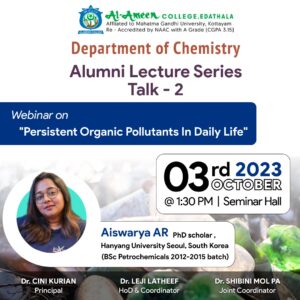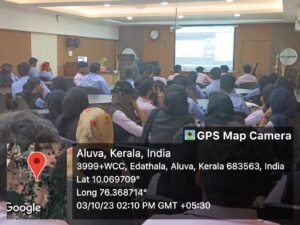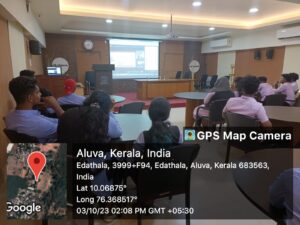






An international webinar was organised by the chemistry department by our alumni Aiswarya A.R. , on the topic “Persistent Organic Pollutants in Daily Life”. The resource person of the day Aiswarya A R was our B.Sc. Petrochemical 2012-2015 batch student, currently doing her Ph.D at Hanyang University, Seol, South Korea. The webinar was held on 3rd October 2023 via Google Meet in the seminar hall of Al-Ameen College Edathala. The webinar started with a silent prayer followed by a warm welcome address by our dear HoD Dr Leji Latheef. The objective of the programme was to create awareness about how different organic persistent chemicals tactically play into the ecosystem and how to omit or reduce their uses.
The main area of the resource topic was POPs, a persistent organic pollutant that is a highly unbreakable chemical that leads to serious health issues for humans and wildlife. The main issues discussed by the resource person were:
- Brahmapuram waste yard fire incident
- Importance of Persistent Organic Pollutants (POPs) in daily life.
- Organochlorine Pesticides.
- Effects of DDT and PCB.
- Bioaccumulation.
- Criteria of POPs.
- Persistent Organic Pollutants and Male reproductive health.
The resource person started the session by explaining the unpleasant incident that happened last year and the Brahmapuram waste yard fire incident that occurred in March 2022. The solid waste treatment plant in Brahmapuram has gone up in smoke. This major fire and the smoke created after the fire at the Brahmapuram waste plant in Kochi have left toxic fumes that have enveloped the city for over a month. Kochi was facing heavy air pollution due to toxic fumes from burning plastic waste etc. The pollution caused by the chemicals mainly comes under Persistent Organic Pollutants (POPs). These are chemicals of global concern due to their potential for long-range transport, persistence in the environment, ability to bio-magnify and bio-accumulate in ecosystems, as well as their significant negative effects on human health and the environment. She also explained the most commonly encountered POPs are organochlorine pesticides, such as DDT, industrial chemicals, PCB, etc. Organochlorine (OC) Pesticides are synthetic pesticides widely used all over the world. The toxicity of these chemicals was well discussed.
The chlorinated hydrocarbon derivatives have vast applications in the chemical industry and agriculture. These are well-known for their high toxicity, slow degradation and bioaccumulation. Even though many of the compounds which belong to OC were banned in developed countries, the use of these agents has been rising. She also gave an idea about Polychlorinated biphenyls (PCBs). They were used as cooling fluids in electrical equipment and machinery, because of their durability and resistance to fire. The toxic effects of these chemicals were unpredictable.
The topic covered by the resource person is well suited to the present scenario since persistent organic pollutants (POPs) are dangerous chemicals that seriously affect living things and the entire planet’s ecosystems. POPs stay on for a long time, are extensively distributed throughout the environment, accumulate and intensify in living organisms through the food chain, and have harmful effects on wildlife.
The issue discussed by the resource person was clear and quite interesting. Finally, the session opened for discussion, the audience cleared their doubts and after all, she delivered an idea about different career opportunities in the field of chemistry and also in South Korea, Japan and other countries.